A default-model swap exposed an undefined document-language policy; a later harness audit narrowed the claim
A July synthetic harness recorded different language choices across two models and motivated separate document and conversational language policies. An August 10 audit then found a missing runtime prompt tail, unmeasured BARE branch, and wrong transport, withdrawing production-effect rates.
- runtime tail omitted, BARE unmeasured, transport unlike production
- 3 fidelity breaks
- production-causal and post-fix rates from the historical synthetic harness withdrawn; faithful rerun required
- Superseded
Question: Did a default-model swap cause the document-language regression, and was it impossible to fix in the prompt?
Observation: A July 2026 synthetic run recorded a model difference, but an August 10 audit found that it omitted the production prompt tail, used the wrong transport, and never exercised the BARE branch.
Decision: Keep the explicit language policy and code boundary, demote the old rates to historical observations, and rerun them with a production-faithful harness.
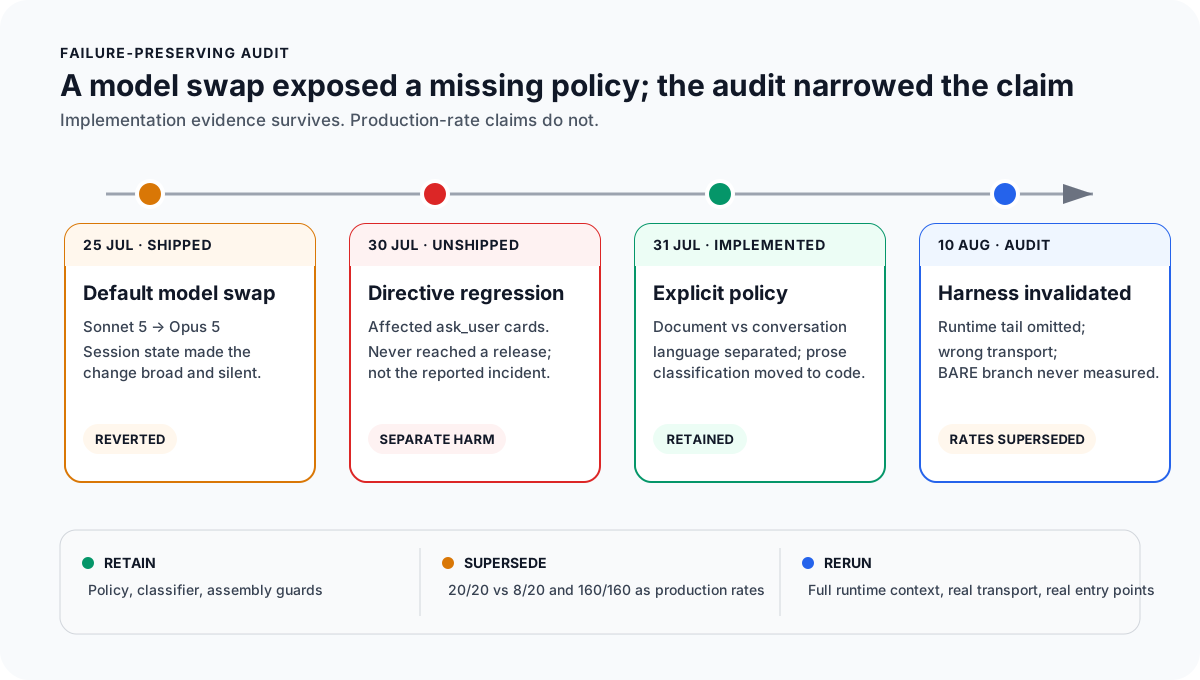
1. Separating two incidents behind one user report
The report was that an app-written document read like a literal Korean-to-English translation. The verified sequence is more precise:
| Date | Verified event | What the evidence can support |
|---|---|---|
| 25 Jul 2026 · v1.6.2 | Default changed from Sonnet 5 to Opus 5 | 000d86b0 and session-state behavior explain a silent, broad switch |
| 30 Jul 2026 · unshipped | A separate language directive regressed ask_user card language |
It reached no release and did not cause the user report |
| 31 Jul 2026 · implementation | Document policy was made explicit and prose/bare classification moved into Rust | The current code and regression tests preserve this boundary |
| 10 Aug 2026 · audit | The July harness was found not to be production-faithful | Production interpretations of its rates are superseded |
The default change fits the report’s timing and a synthetic comparison found different model behavior. The reported “strange grammar,” however, was never scored. The July 30 directive regression was also a separate, unshipped defect. They cannot be presented as one causal chain. The primary record makes that distinction in docs/details/language-directive-document-language-2026-07-31.md §§1 and 7.
2. What the July run actually observed
The historical comparison used a one-turn synthetic history with no language directive: an English prose request about a Korean note, followed by document generation.
| Model and condition | Kept source language | Preserved source quotation | Current interpretation |
|---|---|---|---|
| Sonnet 5 · n=20 documents · no-directive synthetic prompt | 20/20 | 20/20 | Historical harness observation |
| Opus 5 · n=20 documents · same synthetic prompt | 8/20 | 8/20 | Historical observation; exact count needs reconciliation |
The recorded comparison gives Fisher p=4.5e-5 · n=40 documents · 20/20 versus 8/20. Current code comments, however, say that Opus translated 9/20 documents under the same condition, implying 11/20 retained rather than the primary record’s 8/20. The raw generations are not in the repository, so the exact 8/20 count and its p-value remain provisional.
Quotations were preserved in 24/24 historical synthetic documents written in the source language and 1/26 historical synthetic documents written in another language. That is a strong association in this sample. The counterfactual claim that changing language caused the quotation mutation was not measured.
3. Prompt trials: separating observations from conclusions
Five policy wordings were compared in cells where material language, turn language, and UI locale disagreed. Representative historical results were:
| Historical wording and synthetic condition | B: English material · bare · ko UI | F: English material · Korean prose · en UI |
|---|---|---|
| No language section | English 50/50 documents | Korean 29/29 documents |
| “Follow the material” | English 30/30 documents | Korean 0/29 documents |
| Code names material language in the header | English 30/30 documents | Korean 11/20 documents |
| The same name only inside a conditional | English 17/30 documents | Korean 19/20 documents |
This supports only the statement that the tested wordings did not jointly pass the selected synthetic cells. It does not show that a prompt could never work. In fact, Opus 5 with an explicit directive passed 30/30 documents under the same old harness.
The later harness audit is more damaging to the original interpretation. Cell B was designed as bare, but the assembly call passed user_message=None, pinning every cell to the PROSE half. These results therefore cannot measure the model’s ability to distinguish prose from a bare trigger.
4. The retained implementation: policy and code boundary
The current policy has two layers:
- A document body is written in the caller’s UI locale.
- Conversation and narration follow the person’s prose language, or the UI locale for a bare trigger.
Code does not generate the language decision itself; it decides which half of the directive to include. turn_has_prose removes a leading slash command, wiki links, code spans, paths, and URLs, then checks whether at least two letters remain. build_system_prompt and the turn_has_prose tests in src-tauri/src/agent.rs preserve that boundary. appended_prompt_sections_start_a_new_block also guards the assembly seam that once attached the language section to the preceding list item.
This is not the discovery of an objectively correct language. It is an explicit product policy. An English-UI user working in a Korean vault pays the cost of receiving English documents, and there are no outcome data yet for ja/zh/es/fr/de beyond the measured ko/en pair.
5. The August 10 audit that superseded the interpretation
The follow-up audit compared what the old evaluator assembled with what production actually runs.
| Earlier record | Audited condition | Status |
|---|---|---|
| “The real assembled production prompt” | Omitted memory, live entity index, DESIGN.md, and /goal clauses appended after build_system_prompt |
Retract production interpretation |
“Production Anthropic /chat/completions” |
Every 30–31 July recorded value came from /responses |
Correct the transport record |
| “Bare cell measured” | user_message=None pinned every cell to PROSE |
Retract BARE result |
| “160/160 after the fix” | n=160 successful documents came from the same incomplete harness | Retain only as historical regression output |
The evidence is in the “Assembly (corrected 2026-08-10),” Transport::resolve, and runtime_context notes in src-tauri/src/agent/eval_card_language.rs. The code explicitly says that runtime_context=none reproduces the July setup byte for byte, and that no user with an open workspace receives that setup.
6. Claims retained and questions reopened
Retained: the v1.6.2 default-model history, the absence of an explicit document-language policy, the separation of document and conversational language, the deterministic prose/bare classifier, and the assembly-boundary test are verifiable in history and current code. 20/20 versus 8/20 and 160/160 stay on the record as historical harness observations so the failed evaluation is not erased.
Not currently claimed: that the model swap caused every part of the user report; that prompt engineering was impossible in principle; or that the old numbers estimate a production failure rate or post-fix success rate.
A valid rerun must use the full system prompt after append_runtime_context, the real Anthropic transport and streaming conditions, real button/suggestion-card/attachment entry points, and all seven supported locales. It must retain prompt dumps, request conditions, raw generations, and per-cell classifications so the exact count can be audited.
Reproducibility and evidence boundary
| Evidence | What is currently verifiable | Boundary |
|---|---|---|
docs/details/language-directive-document-language-2026-07-31.md |
July design, aggregates, and the rationale used at the time | Raw generations and the batch script are absent from the repository |
Git 000d86b0, fc294bdd, and v1.6.1–v1.6.3 tags |
Order of the default change and later preference persistence | Does not prove the full causal effect on the user report |
src-tauri/src/agent.rs, prompts/system/language*.md |
Current policy, classifier, and assembly tests | Code tests do not establish model compliance rates |
src-tauri/src/agent/eval_card_language.rs |
Missing runtime tail, wrong transport, and unmeasured BARE branch | No new production-faithful result has been recorded yet |
| Public 20/20 versus 8/20 and 160/160 figures | Historical old-harness aggregates | Do not cite as production rates; 8/20 conflicts with current code comments |
What this measures
- Consilience
A general-purpose AI agent that uses a knowledge graph for coding, design and answering questions. It builds and maintains ontologies from documents without a resident engineer.